Tuesday, March 8, 2011

First Response: Realism


The Hurt Locker is an Oscar winning movie that takes place during the Iraq War. It centralizes around an Army Bomb squad that’s the top of its class. The movie describes in amazing detail how tough it is for the men in this high stress job, and environment. There are quiet moments of them alone, explaining further the hardship it takes, and most importantly in the end the addiction of war.
Growing up as an Army brat there have been many movies that feel especially real to me because of stories and photos passed down from my father. But in particular The Hurt Locker does even more for me where the main character is in a moment of his own. I have always wondered and examined what goes through my father’s head in situations like dismantling a bomb or attacking a camp, and this movie actually puts me there. There is almost a moment of silence and peace and just your own heart beat and breathing when something that intense is happening. Instead of loud guns and yelling, according to my dad, that it’s really serene in a weird way. Also the addiction of war and the need to be deployed is a real and honest emotion & addiction, and I think this is one of the only war movies that touch on that VERY important aspect.
The type of realism this film used is a very personal one. Sometimes war movies can be too staged and too loud, which is what doesn’t seem real to those who have actually been in war. There is probably some kind of “coded” realism that isn’t apparent to everyone and that’s what makes it such an interesting film, it has a different spin on what’s been usual before. There isn’t a lot of action or music during the “real” scenes just breathing and white noise in your own mind. I think that’s what enhances the film’s realness.

Kasey Hartsock

Fictional Character: Cleo 9-5 Response


Betsy is a 19 year old college student just as excited as all her other classmates for this years spring break.  Cancun, Mexico is where her and 4 of her closest friends decided to party in the warm sunny climate.  Suitcases filled with new swimsuits, hats, sunglasses, short shorts, and tank tops covered her dorm room floor. Gathered in the lobby with smiles on all there faces took one last look in there purses to make sure that they all had there passports along with there plane tickets. Check that off the list!

            Arriving at the Marriot Resort they all raced to the suite with the bellhop far in the distance.  Quickly ripping off the tags of there swimsuits headed out to the gorgeous infinite pool.  The smell of the coconut mixed drinks, along with sun tan oil distracted them from one missing person.  As the day progressed with the bar servers coming to there pool chairs taking orders, they finally noticed that Betsy was not with them.

            They all looked at each other with awe in their faces and began to panic.  Running in the lobby the out spoken one asked the concierge if he happened to see a small white girl with red hair walk in with a bright pink suitcase. With the 5 seconds of silence they couldn’t take it and went straight up to the room to see the horrible sight of there best friend drenched with blood in the bathtub.  Screams were heard miles away reporters say. All the friends looked at themselves knowing they had a horrifying mystery on there hands.

Kasey Hartsock

Linklater Response:


1. Price makes a lot of interesting points and ties together common themes, which include the link between idleness and culture. He states that Linklater increased mainstream fantasy of low budget very narrative films. He was known for strong literary and bringing philosophical awareness into play.
The idea of idleness runs throughout all of his work and the sense of time. The thought of daydreaming is actually productive instead of working all day but idleness is not for everyone and the line is often blurred between that and laziness.  


2. I think he means the way the spectator interacts with the film and its characters is completely up to the director and the style. It’s their way of communicating and showing their art, or their film in the way they choose. If no thought is put into style then they can’t know or control the outcome of the audience and can’t anticipate how they’ll feel while watching.

I personally love the approach of making Before Sunrise with a little bit of improv because it actually does make it feel more realistic. By including more than one writer in the script’s choice and giving the actors many opportunities to bring personal variety in, it makes this love story more tangible. It’s also interesting to watch the film then realize that Linklater gave this leniency to those involved, it probably changes some point of views about the film.

3. Ever since I’ve seen Linklater’s film Tape I have been interested in this idea of time expanding only as long as we’re watching or a movie based on time can actually be used an artistic device. That relationship can enhance or even take away from a film and its meaning. In other tools of art like painting, or dance, time can’t possibly be used in the same way as in film. And that’s because the way the art is performed, and reality in the moment. Nothing can be as time related as a film where we can see many different points of view and different scenes.

Kasey Hartsock

Response to: Do the Right Thing.


1. I wasn’t assigned a color because of my absence but I picked up on the color yellow when I watched it later. The color doesn’t stand out as something violent or extremely vibrant but more as a neutral I think. Yellow is typically a very calming color and I notice it a lot on customers of Sals in the background. There is a very noticeable yellow tint to some of the film, for example the sunshine and street lamps. It’s a very soft color that gives warmth and depth to a lot of the scenes.

2. I know the typical reaction to Mookie’s action at the climax of the film is a negative one that is characterized as self-righteous but I tend to believe it saved the lives of Sal and his sons. Because of Sal’s non-reaction to Radio’s death I think the riot would have easily gone in an even more negative direction if Mookie hadn’t distracted the crowd by throwing the trash can. It caused a big commotion towards the pizza place and I think his actions were justified.

3. I don’t necessarily think the movie was a political one, even though politics were involved. I think it’s more of a personal story movie with a background in politics using them as a backbone for the plot and reason to spark conflict between characters. There also is no specific political point being proven throughout the film. Politics is just used as an antagonistic character for the most part. 

Kasey Hartsock

David Cronenberg

In an article defending David Cronenberg's film, A History of Violence, a commenter referred to Cronenberg as, “film for film, the most audacious and challenging narrative director in the English-speaking world.” And when one looks over Cronenberg's fairly sizable body of work, it becomes clear that this comment does not go undeserved. Cronenberg's movies are known for being unsettling, disturbing, surreal, and in no small part, somber. Yet, when Cronenberg combines these various elements, he uses them to create a number of compelling stories that are, if nothing else, memorable.


Born in 1943, not much is known about Cronenberg's life, other than the fact that he was heavily interested in bugs as a child. Cronenberg states that he was inspired to take up film-making when, during his time in the University of Toronto, a friend of his by the name of David Secter directed and screened a film called “Winter Kept Us Warm.” After writing and directing two short films, Cronenberg went on to direct a number of smaller films, none of which gained any particular notoriety, until Shivers was criticized by a prominent film critic as being disgusting, repulsive, and, as it was made using funds from the Canadian government, a gross waste of taxpayer money. Although the ensuing controversy greatly hindered Cronenberg's film-making career for a long time, making it much harder for him to find funding for his films, one could argue that it also ironically made his career what it is to this day.

The films I will be describing, which are Cronenberg's remake of the classic 1958 film, The Fly, as well as the film adaptation of William S. Burroughs' novel, Naked Lunch, are both examples of various stages throughout his film career. One of the predominant subjects Cronenberg examines is psychology, and the mistakes humans make as a result of their natural desires and fears. In earlier films, such as the aforementioned Shivers and Rabid, Cronenberg explores how our advancement of science and the various ways we tamper with our bodies can lead to disaster on a large, even global scale. By trying to control the body, to make humans more aware of it in Shivers, and to keep it from dying in Rabid, doctors and scientists unwittingly unleash dangerous, disease-like organisms that threaten to overtake humanity.

In The Fly, though, Cronenberg marks the second phase of his films, where he strips down much of the chaos and allows us to explore how such changes affect people on a more personal level. Scientist Seth Brundle invents a revolutionary device which, with some significant tweaking, manages to properly teleport organic matter. To have the device approved by the company he works for, Brundle teleports himself to make sure that the method he found is foolproof. The problem is, he does this while his mind is clouded with jealous rage and copious amounts of alcohol, so he fails to notice when a fly makes its way into the pod with him.

And it is from here that the film introduces us to Cronenberg's bigger trademark. Cronenberg is widely known as the father of the “body horror” movement, a movement of stories in various media that take human beings and horrifically alter their bodies, often turning them into beings that are virtually indistinguishable from the humans they once were. In the case of The Fly, the consequences of having the fly merged with Brundle's DNA is what Brundle himself refers to as the “Brundlefly”-over the course of the entire movie, he makes a slow, agonizing transformation, wherein what appears to be an allergy rash slowly worsens, blisters and lesions forming all over Brundle's body to the point where his extremities are bloated and tumorous in appearance. His nails fall off, his hands and feet grow pads that allow him to walk on walls, and he has to puke an enzyme compound onto any food he eats, because it has become the only way he can eat it. Finally, Brundle's jaw detaches from his head, which promptly splits open and reveals a gigantic bug head underneath, and with his skin falling off to reveal a mostly insectoid body, the grotesque transformation is completed.


A few interesting things to note about The Fly are the context in which it was released, which had an impact on how the narrative was interpreted, and the steps taken to realize the iconic final transformation. The film was released in 1986, in the midst of the AIDS epidemic in the United States. When people saw the slow, grueling processes the fly transformation forced Brundle through, many of them saw the transformation as an allegory for AIDS. This, apparently, surprised Cronenberg, who had intended the transformation to be an overarching metaphor for general disease, aging, and death. Cronenberg also utilized a new technique to achieve the head-splitting scene; rather than use an air bladder, which was the standard at the time and becoming increasingly well-known amongst the public, Cronenberg chose to use an animatronic insectoid head constructed from a number of plates and springs, the force of which, when released, split open the more humanoid head.


The later phase of Cronenberg's work mostly discarded the pretense of science gone awry

and the consequences of body modification in favor of exploring the human psyche,

therefore moving further inward in his explorations of humanity, his latest two films discarding

the body horror trope altogether. Naked Lunch is one of the first movies in this vein, a story

about an exterminator who, through a series of events that would be near-impossible to

describe in a coherent fashion, is forced to retreat to a colony of alien beings in North Africa and

write reports to an agency he has only recently discovered he is a member of. As he comes to

discover that a doppleganger of his wife, who he accidentally killed earlier in the film, is living in

the colony as well, he chooses to follow her down a deep, nightmarish spiral of deception, crime,

and above all, the total breakdown of everything he has accepted as reality.

In its incoherence, Naked Lunch evokes images of the work of Franz Kafka-both works deal

with a bizarre reality that is far detached from our own in nearly every aspect. If The Fly were

The Metamorphosis, a story where a man transforms into a giant bug and slowly succumbs to

his new instincts as he struggles to stay hidden from his loved ones, then Naked Lunch is The

Country Doctor. The pacing is frantic and rushed throughout, hurling event after event at the

viewer, and the events themselves are bizarre and nightmarish for the sake of being bizarre and

nightmarish. In one particular scene, Bill, the exterminator, gives his lover a dose of a highly

potent drug and asks her to write on her husband's prized typewriter. The viewer is expected to

have come to terms with the fact that, in Interzone, typewriters are actually living beings that

resemble bugs with sphincter-mouths on their abdomens. This particular typewriter is a special

case, though, as the viewer soon learns... Joan, in her sudden ecstasy, fails to notice as the

typewriter's keys flip around, and without paying it any mind, she digs her hands into a vagina-

like orifice with the same diligence she typed with just a few seconds prior. The disturbing

sexual imagery only escalates as a hole in the typewriter's back opens, releasing a phallic muscle

that “erects” itself, stiffening and quickly growing in length. The typewriter's margins inhale and

exhale like lungs, and bit by bit, the typewriter unfolds itself until it is no longer a typewriter,

but a grotesque flesh insect. Forgetting the typewriter altogether in their shared arousal, Bill

and Joan proceed to make love, completely unaware that the typewriter creature is trying to

join in, flopping about on both characters' shoulders and snarling with some carnal desire.

While the majority of the film explores sex and how one man struggles to cope with a world alien to his own, Cronenberg does manage to sneak in a subtext of the consequences of body modification through drug usage. Bill's problems first arise from his wife's abuse of the very insecticide powder he uses on a daily basis... forced to confront her after running out of powder on the job and angering his employers in the process, he is eventually talked into taking a dose of powder himself. He is later confronted and arrested by a pair of detectives (Presumably after his boss left a tip that he may be stealing the powder). Using the powder as a segue, they introduce him to a cockroach creature, who first informs Bill of his standing in the agency, his wife's position as an agent of the opposing forces, and the existence of Interzone.

Later on, Bill discovers a drug known as black meat, which is produced from the bodies of giant centipedes (Another motif in the film is that centipedes appear frequently), and begins using it himself. Part of it is the pressures of the people around him, but above all, his use of the black meat is an attempt to cope with the frightening new reality he is being forced to accept. Even as he learns of the unfortunate side effects, namely withdrawal symptoms and sores that form wherever he applies the drug, he continues to use it freely. And if not a direct cause, the effects of the constant abuse of the drug do nothing to alleviate the mental breakdown he suffers as he is left by his friends and struggles to find someone, anyone, that he can trust.

Finally, at the climax of the film, drug usage is also portrayed as a means of slavery. Twice, the viewer has familiarized themselves with the Mugwumps, vaguely humanoid beings who, as the viewer has been told, secretes a highly addictive hallucinogen from glands protruding from their heads. As Bill enters the antagonist's compound, he finds a number of Mugwumps chained up and muzzled, with people who were assumed to have been jailed in a more proper fashion chained up nearby and continuously suckling off the Mugwumps' glands. There, they are left to spend the rest of their lives in unending bliss, but at the cost of their own freedom-their chains keep them from ever running away, and with the Mugwumps always freely accessible, they will never have the desire to.

The ending to the film also matches the endings to many of Cronenberg's other films. Upon finding Joan being held captive in the compound, Bill offers to defect from the agency to the antagonist's home country in exchange for her freedom. In effect, Bill is abandoning the very mission he was always intended to accomplish in exchange for a woman who reminds him very much of his deceased wife. He is exchanging security in a world he fails to comprehend for the last fragment of his former life, and, by extension, his sanity. Upon reaching the border, though, he is stopped by soldiers who, learning that he is a writer by trade, demand to see proof that he is what he claims he is. Rather than write something, though, Bill is forced to murder Joan in the same exact way he murdered his wife.

As he is allowed into what is essentially enemy territory, it becomes clear that, for all the things he has endured throughout the film, Bill has come out of it empty handed. His companions have either been murdered somehow, or traveled somewhere he can never go again. He has surrendered himself to the forces behind everything wrong with the new society, and the only thing he has to show for it is the corpse of the woman who would have helped him endure it all.

The Fly ends on a similarly somber note-as his condition worsens, Brundle finds himself forced to surrender to the primal instincts and insanity he has been staving off over the course of the film. In a last ditch effort to ground himself, Brundle kidnaps Veronica, his love interest throughout the film, and attempts to fuse himself with her, as well as his unborn baby, confident that this will help him to retain what remains of his humanity. The process is stopped by Veronica's ex-lover, though, who manages to deactivate the pod she is kept in just as the teleportation process begins. As Brundlefly attempts to break free, it is teleported with a sizable section of the pod, further mutilating its body as the two are fused.


Brundle, or what remains of Brundle, is reduced to a crippled, crude rendition of a cyborg, with bits of machinery and wire protruding out of its various extremities. If Brundle is allowed to live, it is all too clear that all its existence will be is a never-ending life of agony. Veronica is initially unable to deliver the coup de grace to Brundle, but with his last act of humanity, Brundle holds the barrel of the shotgun to his head, wordlessly begging Veronica to put him out of his misery. The last image is of Veronica collapsing to her knees in despair... she has not simply killed a creature, but her lover, the man she has fallen for over the course of the film and the man she fought so hard to save.

Cronenberg has stated that he is an atheist, and that he firmly disbelieves in an afterlife of any sort. Using this information to add further context to his consistently somber endings, it seems that Cronenberg presents us with an idea he himself has long since come to accept, that he almost demands we accept as well. The world is a cruel place, and the only thing that is lasting and consistent is chaos. Nothing you do, whether it be a scientific discovery you pursue or a life of virtue, can save you from your inevitable fate, or the turbulent forces of nature around you. In this world, the “good guys” do not always win, and more often than not, they actually find themselves punished for their efforts. And there is no “but” that can alleviate any of this, so live your life while you can, because once you die, there is nothing.

And in this, Cronenberg would again parallel with Kafka's work-Kafka himself continues to be notorious for his own series of somber stories with downcast endings. In The Country Doctor, the titular doctor's efforts to save a young boy from death only result in the ruin of his own life, which echoes the ruin of Bill's. His beloved maid is ten miles away, being violated by a perverted stranger with nobody to help her. Upon arriving at the house of the boy's family, the doctor found himself stripped naked and forced into bed with his horrifically wounded patient, who only grew more irritated at the doctor's presence. The boy's injury proved to be incurable and fatal, the only relief the doctor was able to provide being spiritual in nature. And now, after all of this, the demonic horses that took the doctor to the boy's village at an incredible speed move at a slow speed, hardly sufficient to bring the doctor back to his home, ten miles away, in time to save himself, much less the maid. And now, naked and alone, the doctor is left to regret the choice he made in attempting to save the boy: “Once one responds to a false alarm on the night bell, there’s no making it good again-not ever.”

Whether or not he is a modern-day Kafka, though, Cronenberg's work is very important. Cronenberg forces us to think. He forces us to re-evaluate our own interpretations of the world around us. He forces us to question the miracle cure of the day, from stem cell research to nanotechnology, and ask ourselves-”what's the catch?” And anything that forces us to think, in this day and age, is completely invaluable.


Martin Scorsese

Martin Scorsese (born November 17, 1942) is a prominent American film director, screenwriter, and producer. He is a native New Yorker and earned his M.F.A. in film directing from the NYU Tisch School of the Arts. He is considered to be one of the most influential American filmmakers of his era. His films include Taxi Driver, Raging Bull, Goodfellas, The Color of Money, Casino, The Aviator, The Departed, and Shutter Island. He tends to develop long-standing collaborations, such as with actors Robert De Niro (with whom he has made a total of eight films), Harvey Keitel, and Leonardo DiCaprio, as well as editor Themla Schoonmaker and writer Paul Schrader.

Throughout his body of work, Scorsese repeatedly addresses such themes as identity, corruption, guilt, redemption, and violence. His protagonists are often social outcasts or pariahs; they may be corrupt, violent, or criminally insane. They have strong, turbulent personalities and are usually extremely flawed, elements which generally help to drive the plot. His films are frequently set in large cities, particularly New York, and often deal with corruption and violence in city life. Environment plays an important part in his films, with the grit and tension of the atmosphere greatly affecting the ‘feel’ of the movie. Visually, the camera work in his films is consistent; he is fond of mixing long tracking shots and slow motion with fast-paced editing of sequences. The unifying feature of Scorsese films is the way that he uses these elements to help the audience experience events in the same way that the protagonist experiences them, and to keep the viewer unsure of what will happen next.

Two examples of Scorsese’s personal style of filmmaking are Taxi Driver and The Departed. Both films take place in large cities – New York and Boston, respectively – and feature characters that live outside the confines of everyday social norms and rules. Both films also feature the steady decline of the main character’s mental stability as the plot progresses (Travis Bickle’s descent into depression and violence in Taxi Driver; William Costigan’s increasing paranoia and alienation in The Departed). Violence is a prominent feature in both storylines, as is a subjective, dreamlike quality aimed at involving the viewer in the protagonist’s emotions and experience, and heightening the suspense.


Filmed in 1976, Taxi Driver is considered one of Scorsese’s greatest films and sealed his reputation as a skilled director. Set in New York City shortly after the Vietnam War, the story revolves around Travis Bickle (Robert De Niro), an ex-marine who presumably served in Vietnam (although there is no real proof of this). Travis suffers from depression and insomnia. To cope with the sleepless nights, he takes up a job as a taxi driver working 12-hour nighttime shifts. He meets and becomes infatuated with a young woman named Betsy (Cybill Shepherd), a volunteer supporter of New York Senator Charles Palantine’s upcoming Presidential campaign. Feigning interest in the campaign, Travis develops a brief relationship with Betsy, which she ends after he takes her to a pornographic movie. Travis slides further into depression, showing disgust at the behavior of his fares. He becomes interested in weapons, illegally purchasing four separate guns and repeatedly practicing drawing them. He also meets a child prostitute called Iris (Jodie Foster) and tries to convince her to return to her family in the Midwest. After some time, it becomes clear that Travis intends to kill Senator Palantine during an upcoming speech. When he attempts to draw his gun on the Senator, he is spotted by Secret Service agents and chased from the crowd. Giving up on the assassination, Travis settles for killing Sport, Iris’s pimp (Harvey Keitel), as well as the bouncer in the brothel and the client in Iris’s room, becoming seriously wounded in the process.


The climactic shoot-out scene at the end of Taxi Driver has become one of the most remembered scenes in movie history. Several techniques were used to make this sequence feel dreamlike and to heighten the dramatic tension. The camera work used a mix of quick and aggressive back-and-forth cuts, long, slow tracking shots which follow Travis’s progress through the brothel, and slow-motion sequences. The set itself is dimly lit and rather claustrophobic; both the hallway (where Travis executes Sport) and the staircase are extremely narrow and confined. The struggle between Travis and the bouncer begins on the staircase and carries on into Iris’s room, where Travis shoots him point-blank in the head in front of the child. Afterward, as Iris sobs in the corner of the room, Travis tries to commit suicide. He clumsily works his way through his weapons, trying to find one with a spare round to fire into his head. The scene keeps this sort of slow tension as the police arrive in the doorway, aiming their weapons at Travis, who mimes shooting himself in the temple. The camera then assumes a birds-eye view and takes a long, slow drift throughout the brothel, down the stairs and out into the street, very deliberately panning over the massive amounts of blood spread throughout the house, and later over the crowds of people gathered outside who were disturbed by the noise. This eerie drift works well with the de-saturated colors in this scene; it emphasizes the dreamlike quality of the shootout and of Travis’s increasingly paranoid state of mind. The de-saturation of the shootout was done in an effort to obtain an “R” rating. As a result, the blood ended up being a much lighter, almost orange color. No matter the intent behind the color change, I personally found that the de-saturation worked in the context of the film. Grittier, darker, more realistic blood may have provoked a more visceral reaction to the scene, but I think Scorsese’s goal throughout the film was to involve the viewer in Travis’s near-fantasy world and the loss of touch with reality that provoked him to do this, and the strangeness of the coloring in the climactic scene only adds to that. Scorsese tends to pull the audience into the protagonists’ experience any way he can. Another way he does this is by manipulating the film’s score. There is no background music to accompany Travis up the stairs to Iris’s room; it only starts to play when the police appear in the doorway afterward. When it does kick in, it’s loud, sudden, and piercing (mainly played on horns). This seems to be a theme with Scorsese and musical scores: he is very aware of how music can affect the audience’s experience of the story. Without the blaring background music, the slow drift through the house following the shootout may have been an opportunity for the viewer to relax, knowing it was all over. Instead, the tension carries on long after everyone is dead.

The denouement following this sequence was also very interesting. A letter from Iris’s father is read aloud in a voiceover, explaining that the girl is home and safe, that Travis had been in a coma for an unspecified length of time, and that the family could not be more grateful for his actions. As the letter is read out, the camera pans over several newspaper articles cut out and pinned to a blank wall, all of which feature Travis Bickle and his heroism in the face of moral evil. I found it very ironic that the media touted Travis as a hero, considering that if he had been successful in assassinating the Senator, he would have been called a villain and a murderer. It was also interesting to see Betsy’s change of heart when she rides in the back of Travis’ cab; she no longer looks at him with disapproval. The sudden optimism of this final scene left me wondering if it was actually a dream; perhaps Travis was imagining himself a happy ending just before he died in the shootout. It just seemed too cheerful and optimistic in comparison to the rest of the film. Yet, that cheeriness is taken away almost as soon as it is shown. As Travis drives off and leaves Betsy on the sidewalk, there is a sudden noise, causing him to look sharply into his rear-view mirror at something the audience can’t see. This is a hint to the viewer that Travis is still not well and most likely will never be well. Scorsese’s characters tend to start out damaged and end up even more damaged. Very rarely does anyone get out unscathed. Scorsese’s later film, The Departed, is another example of this.


Filmed in 2006, The Departed is a remake of the Hong Kong crime thriller Infernal Affairs, which was released in 2002. In the film, Colin Sullivan (Matt Damon) is recruited into the Irish-American mob by Frank Costello (Jack Nicholson). Costello sends Sullivan into the Boston police force as a mole for his criminal organization. Meanwhile, William Costigan (Leonardo DiCaprio) is an undercover policeman sent to infiltrate Costello’s group as an informant. Before long, both sides become aware that there is an informant in their organization; Sullivan and Costigan each try to discover the others’ identity without blowing their own cover.


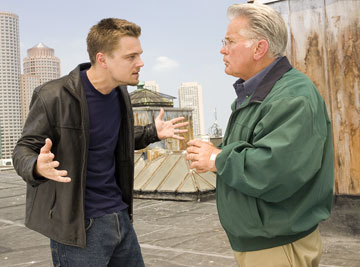
The main theme of this film is the concept of identity and of mirroring. Both the main characters and their associates seem to be mirrored versions of each other, similar figures that happen to be associated with opposite sides. Sullivan and Costello mirror one another, as do the authority figures Costello and Captain Queenan (Martin Sheen); Costello is a father figure to Sullivan, while Queenan is a father figure to Costigan. Throughout the movie there are plot devices and twists that continue adding layers to these connections between the characters. Symbolism is also used to stress this point. There is a scene in the film where Costigan attempts to arrest Sullivan, chasing him through the streets of Boston’s Chinatown at night. At this point each man knows of the existence, but not the identity, of the other. This scene uses symbolism, lighting, and camera editing to further emphasize the concept of identity, and to stress that both characters’ identities are beginning to fragment as they pretend to be other people. There is a moment where Costigan has lost sight of Sullivan, and looks wildly around in all directions; he spots a wind-chime made out of small fragments of a mirror and sees his own face split into many smaller pieces, hinting at his own increasing alienation throughout the film, before noticing the reflection of Sullivan in the background. The lights from neon signs and the steam billowing from restaurants distort and envelop both characters during the chase. In fact, there is hardly a shot in this scene that does not hint at some sort of mirroring or distortion, whether it is the disproportionate shadows of the characters thrown against an alley wall or the exaggerated echo of their footsteps. Nothing appears the way it really is. This is further emphasized when Sullivan, thinking that Costigan is approaching him from behind a delivery truck, leaps out to stab him with a knife. Instead of Costigan, his victim is revealed to be an innocent restaurant employee taking out the trash.

Where Taxi Driver used de-saturated colors to emphasize the dreamlike quality of the shoot-out in the brothel, The Departed did not employ the same technique with its color palette. The blood in this film was very stark and realistic. However, Scorsese manages to inject the same surreal quality into a violent scene by using a different technique: slow motion. In the scene where Costigan meets with his superior, Captain Queenan, in an abandoned building, they are followed by a group of Costello’s men (Sullivan tipped them off). Costigan is forced to go down the fire escape in order to keep his cover; Queenan stays behind to distract the men. When he refuses to give up the identity of his informant, Queenan is then thrown from the roof of the building, landing in the alley at Costigan’s feet and dying on impact. This is one of the most effective scenes in the film because of the way that Scorsese chose to pace the sequence. The camera techniques leading up to Queenan’s death are quick and aggressive, cutting from one subject to another and employing restless, spiraling tracking shots which follow Costigan’s progress down the fire escape into the alley below. When Queenan is shown falling, only one shot is used: he falls into and out of frame in slow motion. After so many aggressive shots and camera movements, the sudden change of pace gives the audience time to let the horror and helplessness of the situation sink in. It also sets up a contrast between the fall and the impact. When Queenan strikes the pavement, it is brutal and graceless. There is a horrible noise, and Costigan is covered in blood from the collision.


Similar to the background music in the climax of Taxi Driver, The Departed employs various tricks with the score in order to heighten the impact of certain scenes. For example, there is a scene in which Sullivan is sitting alone in his office, looking at the cell phone that the (now deceased) Captain Queenan used to communicate with Costigan. Sullivan thinks that he is on the verge of finding the informant in Costello’s group. Throughout the scene, Gaetano Donizetti's "Lucia de Lammermoor" plays loudly in the background, an aria used several times throughout the film, including a sequence with Costello watching a live performance of the same opera. The aria continues until Sullivan flips the cell phone open, bringing the music to a sudden stop and heightening the tension of the moment. This abrupt start-and-stop technique was also prevalent in the scene with Costigan and Costello driving out to a warehouse to make a drug deal. Sullivan calls Costello to let him know that he is being tailed by two police cars. During the phone call, the Dropkick Murphy’s “Shipping off to Boston” is playing at full volume until Costello screams at Sullivan to get rid of the tail, at which point it stops abruptly. The volume of the music in this scene emphasizes Costello’s increasing belligerence, making the aftermath of his shout all the more jarring. “Shipping off to Boston” also appears at several other points throughout the film, and each time it starts and stops according to cues in the scene. The tendency for the background music to start and stop follows along with Scorsese’s abrupt shifts in pacing and editing; the overall effect is that the viewer is unable to predict what will happen next.

All of these effects are used to engage the viewer in the protagonist’s experience, setting up an emotional investment in that character’s fate. Establishing a connection with a character with debatable morality raises questions for the viewer: given the same circumstances, would their own actions be any different? Can the protagonist be seen as a hero, despite their dubious ethics? Scorsese has an interesting outlook on heroism, which can be seen in both of these films. Many similarities can be drawn between the characters Travis Bickle and William Costigan. In both Taxi Driver and The Departed, the main character spirals into a state of depression and alienation over the course of the story. Despite their flaws – one is an outright murderer, the other depressed, disaffected and paranoid – they each elicit sympathy from the viewer, simply because each character is trying, in his own way, to solve the problems around him. Setting characters in a hostile environment encourages understanding and empathy from the audience. In contrast to the actions of those around them, the protagonist’s morally dubious choices seem more righteous and justified than they would in a safer, friendlier environment. Their actions appear immoral – Travis Bickle’s decision to kill those he saw as responsible for Iris’s situation, or William Costigan’s last-ditch effort to regain his identity through blackmail – but it is clear that they are each trying to right a perceived wrong. In fact, both characters are touted as heroes by the end of each film (by people who only witnessed the aftermath of their actions, and had no idea what each character really went through). Scorsese’s take on heroism seems to be that the intent behind an action partly determines the morality of that action.

Martin Scorsese has a very recognizable style of filmmaking, which is evident throughout all of his works. Though the subject matter, time period, setting and implementation may vary, the same basic themes and stylistic choices are always present: violence, guilt, redemption, insanity and alienation. A Scorsese film is always recognizable as such.

Sunday, March 6, 2011

Sofia Coppola

Sofia Coppola was born in New York City in 1971. She is the daughter of Francis Ford Coppola and Elena Coppola. Sofia was born into a very talented family. Her father was and still is a famous director and her grandfather was a talented composer. She started out acting when she was an infant and made several different background appearances in her father’s movies as a child. As she got older and graduated from college, she landed some bigger roles in her father’s movies and even one that was unrelated to her father. Sofia has also appeared in several music videos in the 1990’s.
However, it was in 1989, that she co-directed her first film with her father, titled Life Without Zoe. It was a short film, part of an anthology called New York Stories. After this she went on to direct several films on her own; her first was Lick the Star, released in 1998. Two later films, which I’ll look at for this article are The Virgin Suicides (1999), and Marie Antoinette (2006). The Virgin Suicides was the second film both written and directed by Sofia. It is an American drama that takes place in an upper middle class suburb of Detroit, Michigan during the 1970’s. It tells a story about the suicides of five sisters and the obsession the neighbors (four boys in particular) have with trying to figure out why they killed themselves.

There is a scene about a half way through the movie where one of the five sisters, Lux, played by Kirsten Dunst, is sitting in a theater hall at school watching an educational film about hurricanes with a bunch of other students. There is an empty seat next to her, which becomes occupied by the school heartthrob, Trip, played by Josh Hartnett. Trip has become obsessed with trying to get Lux’s attention because she is the one girl who seems to care less about him and his looks. As he sits down, she goes from slouching in her seat to sitting upright. He looks at her as he sits down and, feeling his eyes on her, she rolls hers in what appears to be annoyance.
Prior to this, their only contact had been when he first saw her. He ducked into her history class on accident while trying to avoid running into the school’s vice-principal. He had just come from his car where he was smoking pot and did not want to have to explain why he was not in class and also why he smelt like weed. So he ducked into the first classroom he came to and sat down in the first seat he saw. Lux was at the desk in front him. She turned around and smiled at him, and that was all it took. He walked past her in the hallway and he was dumbfounded when she did not even look at him. So, when he saw her in the theater hall with an empty seat next to her, he seized his opportunity.

After Trip sits down, and Lux adjusts herself in her seat, they both are looking forward with half smiles on their faces. It is at this point you start to feel that this whole time Lux has wanted the attention from Trip but was probably just playing hard to get. Their smiles stay on their faces and they take turns sneaking glances at each other. After a minute or so of this, they both lean their elbows on the same armrest and they touch. Lux lays her arm all the way down on the armrest and Trip follows shortly after. Their pinky fingers touch each other and as they slowly start to move toward holding hands, another kid in the theater makes a loud, obnoxious noise, causing them to be startled and move away from each other. Embarrassed and nervous after all of this, Trip gets up to leave, but before he does he whispers in her ear that she is a “stone cold fox.” She keeps her eyes facing forward but is smiling and then giggles as he leaves.
During this scene, you feel awkward, excited, nervous and uncomfortable. Here are two teenagers, one with lots of experience in getting attention from girls and not having to do much to receive it, and another with no experience, who is kept away from the outside world except for when she is at school. Trip has to get out of his comfort zone and pursue Lux, while Lux has to deal with being pursued by what is considered to be the coolest, most good-looking guy at school. Teenage years are such an awkward time in a person’s life and then you add having to deal with feelings and talking to the opposite sex, it just makes for such a nerve-wracking experience. This scene does a great job in replicating this experience in a teenager’s life.
The theater is dark, except for the light from the movie, which casts its light upon their faces and adds an overall green hue to the scene. The camera shot is close up on both of them. Lux is chewing gum the whole time, sort of slowly, almost as if trying to draw attention to her mouth. Trip shifts uncomfortably in his seat the whole time while trying to get Lux to look at him. The music from the movie that is playing seems to coincide perfectly with this interaction that is going on between the two of them. It seems to slowly intensify the situation as they get closer and closer to holding hands and then breaks away to calm when they are interrupted. There is not too much color in this scene, which seems to be a foreshadowing of what is going to happen near the end of the movie. It is a very even-toned grey scale color scheme, except for her light pink lips. This seems to be a symbol of some hope for her character as she tries to break free from her lock down of a life and also seems to touch on her rebellious nature, which we see in the scenes to follow.
Sofia Coppola did a great job casting Kirsten Dunst to play Lux in The Virgin Suicides. She must have been impressed with her performance in this film because she cast her again in a later film she wrote and directed, Marie Antoinette. Kirsten Dunst has such an angelic yet mysterious look about her and she fits the role of Marie perfectly.
Marie Antoinette is biographical film based on the life of Maria Antonia Josepha Joanna. She was the duchess of Austria, married off to Prince Louis XVI at the age of 15 to seal an alliance between Austria and France. This movie tells of her questionable behavior while Queen of France, spending massive amounts of money on shoes and clothing, running around to masked balls and failing to produce an heir to the throne. She and Louis XVI eventually do conceive a child, but her expensive taste causes the people of France to blame her for the nation’s debt. There is a scene towards the beginning of the film, where Marie is arriving in France to meet her new husband and family. Before she arrives, she has been completely stripped of her old clothes, and clothed in the fashion of France. She is also alone, as she is not allowed to come with anything familiar from home. She steps out of the carriage and is greeted by everyone who is family and members of the court. As she steps out, she hesitates at first but is all smiles. She walks along the path, which is full of people on either side to see and meet her. The only people who are smiling are the little girls. Most of the people here to see Marie have smirks and looks of disapproval on their faces. There are also your standard catty women in the crowd who cannot help but whisper comments to each other about the new woman in the house. It is a very uninviting moment yet Marie smiles, holds her head up and greets everyone with hello.
Marie is wearing a blue gown with a blue hat while everyone around her is wearing white, cream, earth tones, and light primary colors. Her blue stands out in a crowd full people wearing bland colors. The blue seems to be an indication of her mood; sad and nervous to be in a new place all alone. The blue also sets her apart from everyone else, as if to add to her royalty and to have a “notice me” effect.

This scene makes you feel unwelcome and nervous and little bit excited for Marie. She is a young girl sent away to marry a man she has never met. She is expected to bear an heir to the throne and not disappoint her family back home. She is expected to smile and make everyone happy, which she tries to do from the moment she gets to France. She is intimated at first at how unhappy and unwelcoming everyone seems to be to her, but she does her best to do what is expected of her.
The camera does a great job making you feel this way too. When she first steps out of the carriage it is panned out so that you can see her exiting the carriage and presenting herself to these new people. It then cuts to behind her so that you can see everyone who is looking at her. It constantly cuts from a close up capturing her facial expression, to behind her so you can see what she sees. It also cuts away from her from time to time, and captures a whisper or disapproving look in the crowd. When the camera shots bounce around like this, it really allows you to get a sense of what is going on all around her, and helps develop the feeling of nervousness.
The music that is playing during this scene adds to this unwelcoming but exciting feeling. It is a really soft piano melody that sort of fades out as she begins walking through the crowd. As it fades out, the camera cuts away from her so you can see what she is seeing, which is a bunch of unhappy and critical looking faces.
In both The Virgin Suicides and Marie Antoinette, Sofia does an excellent job capturing and creating mood. She does this with camera angles, color and her actors. She seems to have picked the perfect actors to portray her characters. Kirsten Dunst does such a great job playing these angelic, vixens and it makes for intriguing films.
In The Virgin Suicides, Sofia used soft, pure colors such as yellow, white, light blue and pink. These colors make you think of purity and innocence. She also uses grayscale colors during the more intense scenes, which force your mood to sadness. Then she uses light to cast certain shadows or tints on the scene to give it a more seventies-type feel, as well as helping create the mood of the scene.
Sofia uses a lot of close ups in this movie. This seems to be because she wants to create a serious feeling within the viewer. She wants to be sure you see the detail of the actor’s faces and feel their emotion during each situation. She wants you to sympathize with the characters and the challenges and experiences they are facing.
In Marie Antoinette, she uses a lot of bright pink as well as shades of red and blue. These colors symbolize wealth and youth. Marie loved to spend money on dresses, shoes and jewelry. She could care less if she over spent her allowance. She was so impressed with the amount of things she was allowed to have and get whenever she wanted. All of the things she buys are pink, blue, red, white, and extravagant. She always had the best and was only shown the best by all the tailors.
Sofia’s choice of music for this film makes it feel as if this just happened yesterday. She has it take on a modern feel by using music from today. It causes Marie’s actions to become more appealing by giving it a sound you can relate to. She also does this by focusing on the luxuries of her life. There are quite a few different scenes where you see Marie eating something amazing and pink. There are other scenes where you find her looking at the latest fabric brought in especially for her, and the different types of heels she’s had designed. There are also a few scenes where she is either eating with her husband or waking up in the morning, only to have everyone waiting on her hand and foot. She barely gets to hold her own fork. She also sneaks out and has her own mini palace she can retreat to whenever she decides she wants to party. This seems like such an amazing life, to have whatever you want and do whatever you want. Sofia did not seem to focus too much on the end of Marie’s life. She really focused on her extravagant taste and lust for the outside the world. It sort of felt like she was glamorizing the life of Marie Antoinette and how fun it must have been to be a young queen. She did an amazing job with costumes in this movie, which actually won an award.
Although Dunst plays two different characters in each movie, there seems to be some similarities. Being an Austrian Queen of France comes with its challenges just as being a young secluded girl in her teens. Each character is portrayed as young and beautiful with rebellion issues. Dunst’s character Lux wants so badly to be allowed to do anything outside her house so she begins sneaking out, drinking and smoking cigarettes. Her character as a young Queen of France takes advantage of her role by spending lots of money, sneaking out to parties and keeping bad company.
Both of these films were very entertaining to watch and I will continue to watch them. I think Sofia has done a great job in her career as both writer and director and I hope to see more from her in the future.